
🎧 Listen and Watch Give A Heck Podcast
- 🎥 Watch on YouTube
- 🍎 Listen on Apple Podcasts
- 🎧 Listen on Spotify
- ❤️ Listen on iHeart Radio
- 🎵 Listen on Amazon Music
- 🎙️ Listen on Audible
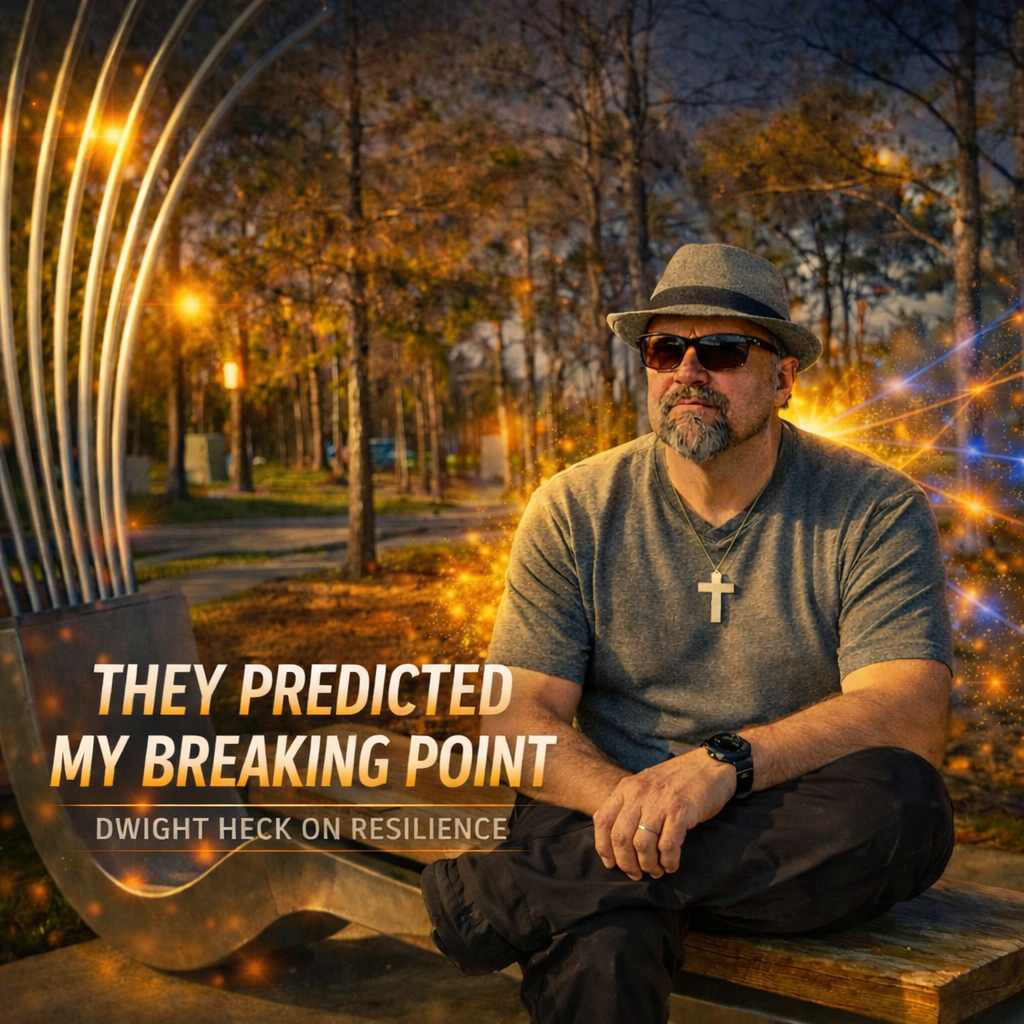
At fourteen, Dwight Heck was told his body would never let him keep up with anyone else. This is the story of the brace, the bullying, and the hike three decades later that proved every one of them wrong.
🎙️ Give A Heck Podcast
Real conversations and solo episodes about purpose, financial stewardship, mindset, leadership, and intentional living. This solo episode goes deep on childhood illness, tenacity, and refusing to accept the ceiling other people hand you.
🔍 Episode Overview
Dwight Heck opens the first episode of a new three-part solo arc, Not by Accident: Three Decisions, with a story he has never told on the podcast before. As a child, Dwight lived with severe, uncontrolled asthma at a time before rescue inhalers existed, a limitation that forced him to give up sports early and made him a target for bullies who saw a kid who could not keep up.
At thirteen, that story got heavier. Dwight was diagnosed with scoliosis, a condition that already ran in his family, and at fourteen he chose a caged steel body brace over spinal surgery, wearing it twenty-three hours a day for almost three years through his biggest growth spurt. Well-meaning adults told him to stop pushing himself physically. Dwight explains why that message, however kindly meant, cut deeper than the diagnosis itself.
Rather than accept the limits he was handed, Dwight describes staying active through sports and starting his own paper route at twelve, running it through the same asthma and allergies that were already working against him. He connects that tenacity to Terry Fox, and to a decision made decades later: three weeks after injuring his Achilles tendon, Dwight still went ahead with a planned hike through The Narrows in Zion National Park.
This episode sets up the next two parts of the arc, in which Dwight tells the story of an entrepreneurial risk that changed his career, and the family decision that shaped him as a father.
📚 What You Will Learn in This Episode
- Why severe, uncontrolled asthma before rescue inhalers existed shaped Dwight’s childhood and led to early bullying
- How a scoliosis diagnosis at 13 led to a three-year choice between spinal surgery and a caged body brace
- What wearing that brace twenty-three hours a day actually involved, and why well-meaning caution from adults can do as much damage as the diagnosis itself
- Why Dwight sees tenacity as a superpower, and how a paper route at 12 proved it
- How Terry Fox’s story shaped Dwight’s view of limitations as a kid
- Why an injured Achilles tendon did not stop Dwight from hiking The Narrows in Zion National Park decades later
- What listeners can do with their own version of a ceiling someone else handed them
📑 Chapter Summaries
0:00 Introduction
Dwight opens with a question: has anyone ever told you flat out what you would never be able to do. He sets up a shorter, story-driven solo episode.
1:07 Severe Asthma and Early Bullying
Dwight describes living with severe, uncontrolled asthma before rescue inhalers existed, quitting sports early, and being bullied for it.
2:18 The Scoliosis Diagnosis
At 13, Dwight is diagnosed with scoliosis, a condition already present in his family on both sides.
3:24 Surgery or a Brace
At 14, Dwight is given two options: spinal surgery with a six-month body cast, or a caged brace. He explains why he chose the brace.
4:32 Twenty-Three Hours a Day
Dwight describes the brace in detail, a steel collar, chin rest, and back bars, worn nearly around the clock for almost three years.
5:47 When Caution Becomes a Cage
Adults telling Dwight to stop pushing himself physically reinforced the same message the asthma had already taught him, that he was fragile.
6:35 Tenacity as a Paper Route
At 12, Dwight ran his own paper route through the same asthma and allergies, collecting money and paying for papers from his own chequing account.
7:47 The Real Message, and Terry Fox
Dwight explains the episode is not really about scoliosis, and connects his childhood view of limitations to Terry Fox’s Marathon of Hope.
8:59 Thirty Years Later, The Narrows in Zion
In the fall of 2020, three weeks after injuring his Achilles tendon, Dwight hikes The Narrows in Zion National Park anyway.
10:52 A Decision Made Long Ago
Dwight ties the brace and the hike together as the same decision, remade every time life gave him a new reason to sit down.
11:38 What This Means for You, and What Comes Next
Dwight closes with a challenge to the listener’s own version of the brace, and foreshadows the next episode in the arc.
🎯 Key Takeaway
Somebody deciding your ceiling does not make it true.
Dwight’s argument in this episode is simple and direct: whether it is a doctor, a parent, a bully, or the voice in your own head, someone deciding they know the limit of what you are capable of does not make that limit real. The brace was real. The asthma was real. What was not real was the story that either of them had to be the end of what Dwight could do.
💬 Continue the Conversation
🎙️ Ken Kunken, Paralyzed at 20 and Built a 40-Year Legal Career
Ken’s story of rebuilding an entire identity and career after a life-altering injury sits alongside Dwight’s own refusal to accept a physical diagnosis as a ceiling.
🎙️ Are You Drifting Through Life, Purpose and Direction
An earlier solo episode from Dwight on the cost of living without intention, a natural companion to the decision-driven arc this episode opens.
🎙️ Move the Line: Embrace Buffet Thinking
Dwight’s solo episode on beliefs that once served but now limit connects directly to the ceiling theme at the centre of this episode.
🎙️ Turning Grief Into Story, John DeDakis
John’s conversation with Dwight on transforming painful experience into something useful pairs well with the tenacity theme in this episode.
🎙️ Stop Fixing Yourself, Derek Rydall and the Law of Emergence
Derek’s near-death story and the idea that limitation is not identity mirrors the argument Dwight makes about his own diagnosis.
🔑 Key Themes Discussed
- Severe childhood illness and the limitations placed on a child by well-meaning adults
- Choosing between two hard options and living with the choice for years
- Tenacity as a learned, practised trait rather than a personality quirk
- Terry Fox and the idea that limitations are only as real as the power given to them
- Physical resilience decades apart, from a childhood brace to an adult hike
- The first part of the Not by Accident: Three Decisions solo arc
🤝 Connect with Dwight Heck
Connect with Dwight Heck (click below to access)
- 🌐 Give A Heck Website
- 🎙️ Podcast Page
- 📺 YouTube Channel
- 🎵 TikTok
- 🐦 Twitter / X
- 🎤 Work With Me / Be a Guest
🎧 Listen and Watch This Episode
- 🎥 Watch on YouTube
- 🍎 Listen on Apple Podcasts
- 🎧 Listen on Spotify
- ❤️ Listen on iHeart Radio
- 🎵 Listen on Amazon Music
- 🎙️ Listen on Audible
💭 Final Thoughts
Dwight closes this episode by asking listeners to think about their own version of the brace, a diagnosis, a comment from childhood, a financial situation someone told them they would never escape. The point is not that ceilings do not exist. It is that the people who hand them to you are not always right, and proving that is not something you owe them. It is something you owe the younger version of yourself who is still listening.
📣 Call to Action
🎧 Enjoyed this episode?
- ✅ Subscribe to the Give A Heck Podcast on your favourite platform
- ⭐ Leave a review at ratethispodcast.com/giveaheck
🎙️ Think you have a story worth sharing?
- Visit giveaheck.com/work-with-me to find out how to be a guest on the Give A Heck Podcast
📝 Full Episode Transcript
They Predicted My Breaking Point. Here’s What Happened
[00:00:00] Dwight: Welcome back to the Give a Heck podcast, where we
challenge survival mode and choose intentional living. I’m Dwight Heck,
and today it is just me and you, no guest, just a solo conversation. I
want to start with a question. Have you ever had somebody look you in
the eye and tell you flat out what you are not going to be able to do?
[00:00:21] Not what might be hard for you, not what you would work at. I
mean, told this is not going to happen for you, so you might as well
stop trying. I have. I was 14 years old the first time, and I want to
tell you that story today because I think a lot of you are carrying
around your own version of it, and I think you need to hear how mine
turned out.
[00:00:46] One more thing before I get into it. This one is going to run
shorter than what you are used to. For me, that is on purpose, short and
sweet, straight to the point. No wandering. Some stories do not need an
hour. They just need to be told, right. I was bullied as a kid and I
lived with a fair amount of fear and dread every day.
[00:01:07] The goal was just to avoid humiliation, avoid shame, avoid
physical pain. So I did what a lot of kids in that position do. I tried
to blend into the background and not draw attention to myself. And the
story I built in my head from that was simple. My dreams did not matter.
I was not as good, not as deserving as the other kids around me.
[00:01:30] A big part of where that came from was my asthma, not the
mild kind, severe uncontrolled asthma my whole life, and this was the
early seventies. Rescue inhalers, as we know them today, did not exist
yet. That limited a lot for me. I had to give up sports early because I
could not physically perform for the length of time.
[00:01:52] Most sports require and kids do not need much of a reason. To
find someone to pick on being this sick kid who could not keep up gave
them plenty. I got bullied for it. On top of that, I was flat out,
taught not to attempt new things, not to push myself physically, not
encouraged to try and see how far I could get told straight up, do not
bother.
[00:02:18] And that was only the beginning, because not long after I
found out I had something else, something that in some ways hit even
harder. When I was around 13, I found out I had scoliosis, a
degenerative curve in the spine. My one sister had already been
diagnosed years before me, so when the signs showed up in me, my parents
did not wait around.
[00:02:40] They got me in to see her specialist. Looking back at it, now
it runs in the family. My paternal grandfather had it mildly. My father
has a touch of it too. It is in two of my five kids as well. Some of
what we hand down to our kids, we never get a vote on asthma, scoliosis,
allergies. The body just does what the body does.
[00:03:04] There’s another kind of inheritance though. One, we actually
do have a say over the things we passed down that have nothing to do
with genetics and everything to do with what we lived through and never
dealt with that one story. It’s for another day. Hang on to that thought
it is going to matter later.
[00:03:24] For now. Back to the brace. So there I am 13 years old,
already dealing with asthma my whole life and now I get handed this and
right around my 14th birthday, the specialist sets me down and says,
here are your two options. Option one surgery. They fuse stainless steel
rods into your spine and then you spend six months in an upper body cast
while it heals.
[00:03:48] Option two, a brace, you wear it basically all day, every day
for years while your body finishes growing. I remember exactly what
scared me about the surgery. It was not the operation itself, it was
what came after. I was told I would never be able to bend down again
like a normal person for the rest of my life.
[00:04:08] I pictured myself walking around stiff like some kind of
robot for the rest of my days, 14 years old and that is the picture in
my head. So I choose a brace. Now let me actually describe this thing to
you because I do not think people understand what the word brace really
meant back then. This was not some soft support you strap on.
[00:04:32] This was a caged body brace. 23 hours a day for almost three
years, right through my biggest growth spurt. It had a steel collar that
went around my neck with a chin rests built into it, and two hard
plastic pads at the back of my head. I could not turn my head not left,
not right. If I wanted to see something that was not directly in front
of me.
[00:04:56] I had to rotate my entire body. There was a five centimetre
thick bar running down from my chin into the hard leather and steel form
that wrapped around my hips, pulling my stomach in about five
centimetres and on my back. Two more steel bars running down either side
of my spine 23 hours a day. I want you to sit with that for a second
because I think it’s easier to hear a story like this and let it slide
right past you.
[00:05:25] Picture being 14 in that thing, in the hallway at school, at
the dinner table, trying to sleep in in it. And here is the part that
struck me more than the brace itself. The adults around me, out of
genuine care started telling me what I should not do anymore. Stop with
the physical stuff. Do not push yourself.
[00:05:47] You need to be careful. I know they meant well. It was the
same message I’d already gotten once with the asthma just louder this
time. But when you were already a kid who has spent his whole life
dealing with asthma, who already feels like he cannot keep up with
everybody else, and now the grownups in your life and confirming it,
telling you that you are fragile, that message goes deep.
[00:06:12] It tells you you’re not like the other kids. You’re not going
to get to do what they get to do. I want to be honest with you, that
message tried to take root in me. When you hear it enough from enough
people who supposedly know better, some parts of you starts to believe
it, but I had something in me that refused to fully accept it.
[00:06:35] I still picked up a bat. I still golfed. I got out on a
bowling team and we won the regional championship brace and all, every
time somebody told me I could not, some stubborn part of me went looking
for a way to prove that I could still could at least a version of it. It
was not just sports. At 12 years old, I started my own paper route,
running it with the same severe asthma and all those allergies already
working against me.
[00:07:05] I delivered those papers and whatever the weather threw at me
and on the days I was too sick. Two, I collected the money myself door
to door. I paid for the papers out of my own checking account every two
weeks. Whether my customers had paid me yet or not, 12 years old,
running a small business, sick or not.
[00:07:26] I think tenacity is an actual superpower. I honestly believe
that, and I think more people need to tap into it. It is one of mine and
I know so many others out there have built that same thing out of
whatever life tried to use to hold them back. That is really the whole
message of today’s episode, if I’m honest with you.
[00:07:47] It’s not really about scoliosis. It is about what happens the
moment. Somebody, a doctor, a parent, a teacher, a boss, even the voice
in your own head decides they know the ceiling on what you are capable
of and hands you that ceiling like it is a fact. I think about Terry Fox
a lot when I think about this.
[00:08:08] A Canadian lost his leg to cancer, told by plenty of people
that what he was planning was not realistic. He started running across
our country anyway, a full marathon every single day starting on the
East coast. He made it 143 days in over 5,000 kilometres before the
cancer that had spread to his lungs forced him to stop.
[00:08:31] He passed away nine months later. He never even finished what
he set out to do, and he is still one of the most important Canadians
who ever lived because of what that run turned into. Millions of people
in over 60 countries now still run every year in his name. What did I
take from that as a kid? That the limitations people hand, you are only
a real, as real part of me as the amount of power you give them.
[00:08:59] So let me take you somewhere else for a minute. Fast forward
more than 30 years past that race. In the fall of 2020, I was invited on
a business retreat with a group of entrepreneurs, and part of that was a
hike through the narrows in Zion National Park. If you’ve ever seen it,
picture a 10 kilometre hike where you’re actually walking through a
river cold water with these towering sandstone walls rising up on either
side of you, it is one of the most beautiful things you will ever do in
your life.
[00:09:31] Three weeks before I was supposed to go, I injured my
Achilles tendon. I’m not going to lie to you for a minute there. I
thought that trip was done, but I made a decision. I went after it the
same way. I went after that bowling championship as a kid in a brace,
physiotherapy three times a week, rehab at home.
[00:09:51] On top of that, I needed medical clearance just to be allowed
on a hike, given the train, and I did not get that clearance until less
than 24 hours before I flew out. I got on that plane not fully knowing
if my body was going to hold up. And I did that. Hike 10 kilometres to
Cold River water between walls of stone that have been standing there
since long before any of us showed up.
[00:10:18] That cold water was actually the one thing that felt good on
the tendon the whole way through. I want you to think about that picture
for a second. A 14-year-old kid locked into a steel and leather for 23
hours a day being told to sit still and stop pushing himself. And
decades later, that same guy rehabbing on an injured Achilles tendon in
three weeks flat so he would not miss standing in a river in one of the
most beautiful places on earth.
[00:10:52] That is not a coincidence. That is a decision that got made a
long time ago. I just kept getting remade over and over every time life
handed me a new reason to sit down here is what I want you to take from
this. Whatever your version of the brace is, maybe it’s a diagnosis,
maybe it’s something somebody said to you when you were a kid that you
still carry.
[00:11:17] Maybe it is a financial situation. Somebody told you that you
would never dig out of whatever it is. Somebody at some point decided
they knew your ceiling, and I’m telling you, they were wrong about mine.
And I think if you actually sit with it, you already know they’re wrong
about yours too. You do not have to prove it to them.
[00:11:38] You just have to prove it to the, to that 14-year-old version
of you who’s still in there listening. That is where I want to leave
this one with you today. Before I let you go, if this one landed with
you, do me a favour and go leave a review. Wherever you are listening to
this, it genuinely helps to show reach the next person who needs to hear
it.
[00:12:00] And if you’re watching this on YouTube, please hit that
subscribe button. I would love to have you back for the next one. If
you’re in Alberta, BC and you want to talk about actual financial
picture, I’m licenced to help you with that directly go to give a
heck.com and book a discovery call. If you are anywhere else in Canada
or anywhere in the world, I still want to talk to you.
[00:12:25] That conversation just looks a little bit different, more
coaching, more mindset, and that is available to you too. Same website.
Now, that story I just told you about, somebody deciding they knew what
I was capable of and being dead wrong. That was not the only time in my
life that happened the next time.
[00:12:46] It was not a doctor holding an x-ray. It was a room full of
engineers who had no idea that a 20 something kid with an electronics
diploma was about to fix the thing they had already given up on. That
one is coming next right here on the Give a Heck podcast. Remember, it’s
never too late to give a heck.