
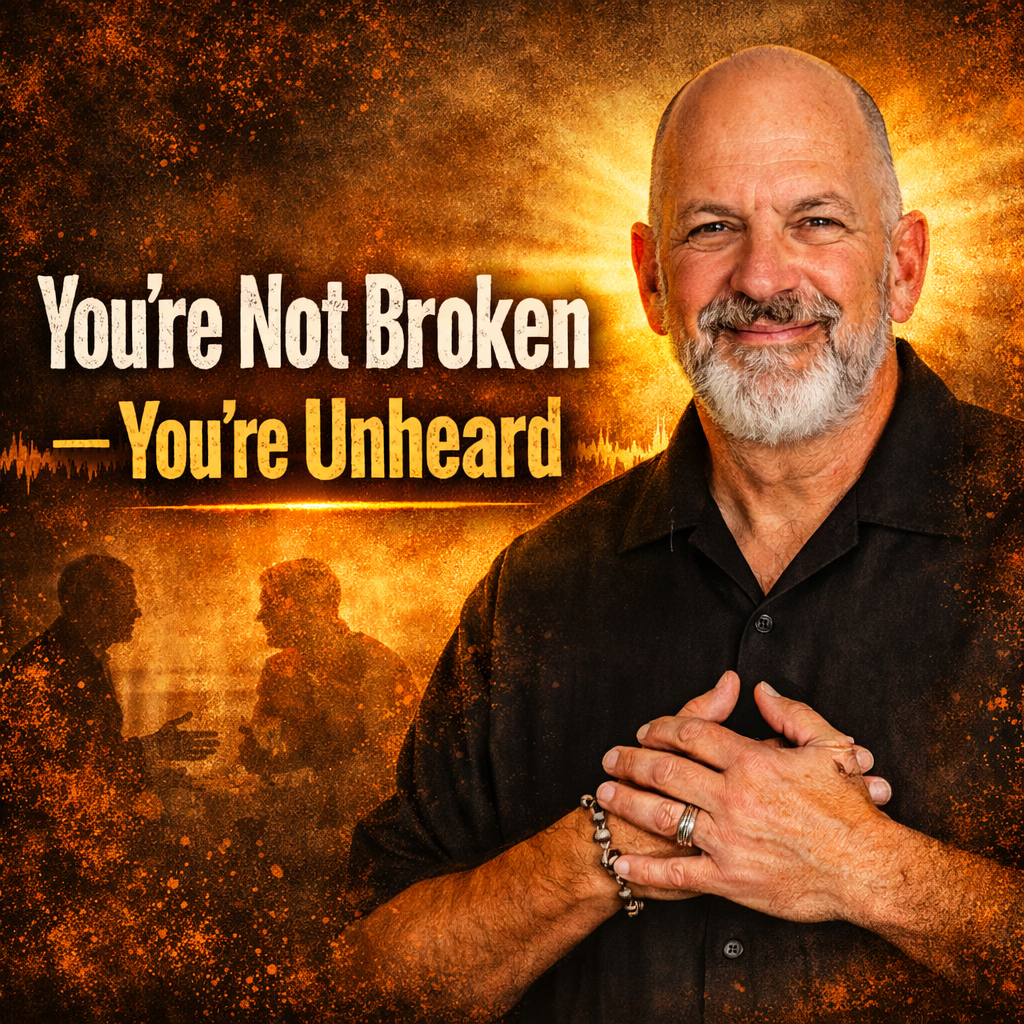
🎧 Listen and Watch Give A Heck Podcast
What if the label you were given — or the one you gave yourself — was never really the answer, and the real problem was never something broken inside of you, but something buried, something unheard, something disconnected from who you actually are?
🎙️ Give A Heck Podcast
Real conversations and solo episodes about purpose, financial stewardship, mindset, leadership, and intentional living. This episode explores what healing actually looks like when we stop diagnosing people and start truly hearing them.
🔍 Episode Overview
Dr. Fred Moss spent more than four decades inside the mental health system as a board certified psychiatrist, treating over 30,000 patients across private practice, correctional healthcare, telepsychiatry, nursing homes, and virtually every psychiatric subspecialty. He saw it all from the inside. And then he chose to ask a different question.
Not what is wrong with this person, but what actually heals a human being. The answer he arrived at challenges almost everything the system is built on. It starts with presence, with creativity, with authentic human connection, and with the radical idea that you are not broken. You are unheard.
In this conversation, Dr. Moss traces his journey from a talkative kid in Detroit who just wanted to communicate, through two college dropouts, a detour into childcare work with adolescent boys, and eventually into psychiatry with one specific mission: to keep human connection alive in a field that was rapidly losing it. In 2006, he made a decision that changed everything. He began taking low-risk patients off their medications with their permission, and watched them heal in ways the system said were not possible.
This is a conversation about what it actually means to hear someone, why most of us are never truly heard, and how that absence of connection is at the root of far more suffering than any diagnosis ever captured.
📚 What You Will Learn in This Episode
- Why Dr. Moss believes there is nothing wrong with you, and what is actually going on instead
- How the psychiatric system shifted from communication to diagnosis and medication, and what was lost in that shift
- What happened when he took low-risk patients off their medications and what it revealed about the system
- Why a psychiatric diagnosis follows you forever and why it may not mean what you think it means
- How human connection is the most profound healing tool known to mankind, more powerful than any medication designed
- What men specifically struggle with when it comes to emotional expression and why it runs differently, not deeper
- How creativity and self-expression are central to genuine mental health, not supplementary to it
- What healthy reinvention looks like in an AI-driven world where job definitions are shifting fast
- Why gratitude practiced daily, even on hard mornings, is one of the most grounding tools available to us
📑 Chapter Summaries
0:00 Introduction and Cold Open
Dr. Fred Moss opens with the core idea that drives his entire work: you are not broken, you are unheard. Dwight introduces the episode and frames what is coming.
1:13 Who Is Dr. Fred Moss
Dwight delivers the full guest introduction covering Dr. Moss’s 40-plus-year career, his training at Northwestern University, his psychiatry residency at the University of Cincinnati, and his creation of the Welcome to Humanity movement.
3:20 Little Freddy, Detroit, and the Need to Communicate
Dr. Moss takes us back to growing up in Detroit with two much older brothers, hitting the ground running as a natural communicator, and spending his school years frustrated that no one wanted to teach what mattered most to him.
8:20 Dropping Out Twice and Finding Psychiatry by Accident
From engineering school at the University of Michigan to Berkeley by Greyhound bus, to computer science, to quitting entirely, Dr. Moss ends up in a childcare role at a state hospital for adolescent boys not because he wanted to be there but because the paycheck came faster.
13:10 Why He Hated Psychiatry and Chose It Anyway
Watching a psychiatrist spend four seconds with a struggling teenager before ordering a sedative injection radicalized Dr. Moss. He decided to enter the field with a heroic intention: to bring communication back to a discipline that was abandoning it.
17:09 2006, the Moment Everything Changed
Dr. Moss begins quietly taking low-risk patients off their medications with their consent. Almost every one of them heals profoundly, losing the very diagnosis that justified the medication in the first place.
19:58 Nothing Wrong With You, the Core Thesis
If the treatments perpetuate the conditions they are marketed to treat, and if no one is to blame in the system, where does healing actually come from? Dr. Moss arrives at the answer: authentic human connection, presence, and being truly heard.
29:13 Dwight Interjects, Shared Observations
Dwight shares his own perspective on the $20 word diagnosis culture and reflects on Dr. Moss’s three-week-at-a-time pattern, which has driven 46 years of sustained commitment.
31:29 Tenacity as a Superpower
Dr. Moss reframes tenacity not as grit but as what happens after giving up. He does not get up fighting. He leaves, and then something pulls him back. He connects this to his current deep immersion in AI and Claude Code.
35:05 How the indoctor Moniker Was Born
At a Vision Quest men’s retreat, a branding specialist friend named Jeff pointed out that Dr. Moss was unmedicated, undiagnosed, and indoctrinating people with unconventional approaches and unconditional love. Five ins. The name stuck.
36:50 Men and Emotional Expression
Dr. Moss pushes back gently on the idea that men suffer more deeply. He argues they suffer differently. The exit flow is blocked, not the depth of feeling. Programming, not pathology.
40:17 Burnout, Expectations, and Find Your True Voice
The pressure of external expectations does not create who we are. Self-expression does. Dr. Moss introduces his second book and the concept of being on board with who you really are.
41:48 Writing Memoirs and Seeing Your Life as One Thread
Writing his third book of 39 stories, including all the ones shared in this episode, allowed Dr. Moss to see that his life was never several segments. It was always one thread. He fed the manuscript into an audio app called Peach and listened to his own story told back to him.
45:22 AI, Claude Code, and Cloning Himself
Dr. Moss describes going deep into Claude Code and building an entire ecosystem of his own material: automated videos, CRM workflows in Go High Level, a full knowledge base of his books and life. Dwight shares his own AI journey and why he fired his podcast production company.
56:17 AI as a Mental Health Tool, the Risks and the Reality
A frank conversation about people using AI as a therapist or confidant, a handful of suicide cases where AI did not slow the process, and Dr. Moss’s own use of ChatGPT to process conflict in his marriage.
59:07 Getting Out of the Wake
Dr. Moss uses a water skiing metaphor to describe leaving the psychiatric mainstream. Once you are out of the turbulence, the water gets smooth. It takes escape velocity to get there.
1:02:56 Reinvention in the AI Era
For those losing jobs or having their roles redefined by AI, Dr. Moss offers a reframe: we have always been reinventing. There was never a fixed version of us that now needs updating. Groundedness, gratitude, and presence are where it starts.
1:04:50 Gratitude as a Daily Practice
Dr. Moss shares his morning ritual: a prayer, both hands on his heart, and ten things he is grateful for out loud before getting out of bed. Alexandra, his wife, is always first.
1:06:35 A Final Word for the Person Carrying Something Alone
When Dwight asks what Dr. Moss wants the person carrying something alone to hear, the answer is eight words: maybe there is nothing wrong with you.
1:10:30 Where to Find Dr. Fred Moss
Dr. Moss shares details about his September Welcome to Humanity retreat for healers and caregivers, his upcoming memoir, and all of his contact and social links.
🎯 Key Takeaway
“Maybe, just maybe, there is nothing wrong with you.”
After 46 years in psychiatry and more than 30,000 patients, Dr. Fred Moss arrived at the simplest and most radical conclusion in mental health: most of what we label as disorder is actually disconnection. The healing is not in the diagnosis. It is in being genuinely heard.
💬 Continue the Conversation
If this episode resonated with you, these conversations go deeper on related themes:
🎙️ Depression at 13: Noah May Speaks Out
Noah May shares his raw journey through depression, anxiety, and suicidal ideation starting at 13 years old, and the turning point that led him to speak out. A natural companion to this episode’s conversation about what goes unheard.
🎙️ Stop Fixing Yourself, Derek Rydall and the Law of Emergence
Derek Rydall makes the same core argument Dr. Moss does, from a different angle: you do not need to be fixed. Everything you need is already present and waiting to emerge. These two episodes make a powerful back-to-back listen.
🎙️ Small Town Kid, Big Life, Jim Tracy on Building Men of Character
Dr. Moss talks about how men block emotional expression rather than feeling it less deeply. Jim Tracy explores what it actually takes to build character that holds up under pressure, and why so many men are never taught the inner work.
🎙️ Why Leadership Burns Out High Performers, Sira Laurel
Burnout is one of the themes Dr. Moss touches on throughout this episode. Sira Laurel goes deep on why high performers burn out systemically and what needs to change at both the individual and organizational level.
🎙️ Chris Shurian on Resilience, Adversity, and Lessons from Bootstraps and Battle Scars
Dr. Moss’s story is one of repeated adversity and unconventional choices. Chris Shurian explores resilience from a similarly hard-earned perspective, making this a strong pairing for anyone thinking about how to keep moving when life pushes back.
🔑 Key Themes Discussed
- Mental health and human connection
- Psychiatric diagnosis and its limitations
- The healing power of being truly heard
- Overmedication and the pharmaceutical system
- Men and emotional expression
- Creativity and self-expression as healing tools
- Tenacity, reinvention, and living in three-week cycles
- AI, Claude Code, and technology as a force multiplier
- Gratitude and daily grounding practices
- Purpose-driven living and authentic connection
👤 About Dr. Fred Moss
Dr. Fred Moss is a board certified psychiatrist, transformational coach, speaker, and author with more than four decades of experience across virtually every corner of the mental health system. He has treated over 30,000 patients in private practice, correctional healthcare, telepsychiatry, nursing homes, and psychiatric subspecialties spanning child and adolescent psychiatry, geriatrics, and forensic work.
Trained at Northwestern University’s Feinberg School of Medicine and completing his psychiatry residency and child and adolescent fellowship at the University of Cincinnati, Dr. Moss spent the first half of his career watching the field shift away from human connection toward diagnosis and medication. In 2006, he began questioning the system from the inside, taking low-risk patients off medications and watching them heal in ways that challenged everything he had been trained to believe.
He is the author of Creative Eight: Healing Through Creativity and Self-Expression, Find Your True Voice, and a forthcoming memoir, Welcome to Humanity: A Psychiatrist’s Case Against the Mental Health System: 39 Stories. He is the creator of Welcome to Humanity, a global community and movement redefining what mental health can look like. He is known to many simply as the indoctor.
🌐 Connect with Dr. Fred Moss
Connect with Dr. Fred Moss (click below to access)
📺 YouTube
🎟️ Welcome to Humanity Retreat (September)
🤝 Connect with Dwight Heck
🎙️ Podcast Page
🎵 TikTok
🎧 Listen and Watch This Episode
💭 Final Thoughts
Dr. Fred Moss did not set out to challenge a multi-billion-dollar industry. He set out to communicate. That is what little Freddy wanted in the playpen, watching the big people talk. It is what drew him into a state hospital at 21. It is what kept him coming back every three weeks for 46 years.
What he found, after treating over 30,000 people across every corner of the mental health system, is that the most powerful healing force available to human beings is not a medication, not a diagnosis, and not a treatment plan. It is presence. It is being truly heard. It is someone looking at you and getting you.
That is a truth worth sitting with.
📣 Call to Action
🎧 Enjoyed this episode?
✅ Subscribe to Give A Heck on your favourite podcast platform
⭐ Leave a review at ratethispodcast.com/giveaheck
🎙️ Think you have a story worth sharing?
Visit giveaheck.com/work-with-me to find out how to be a guest on Give A Heck Podcast
Full Episode Transcript:
Fred Moss [00:00:00]
You’re missing a human connection, and no one is hearing you. You’re not being seen for who you are. You’re burning in a fire that we don’t blame a log for burning in a fire. We’re all living in a fire called life. It’s hard to be here. It’s hard, hard, hard to be alive, and it’s okay. What if we could just be compassionate, accepting, forgiving about all those things.
Dwight Heck [00:00:18]
Welcome to Give a Heck. I am your host, Dwight Heck, and for much of my life, lived my life in quiet desperation wondering how I was going to pay the bills, take vacations, save for retirement, and one day wondering if I would get off the hamster wheel of life and have purpose, a life that most of society lives, which takes us to work, then home, then repeat, and pays us hopefully enough.
Dwight Heck [00:00:42]
Just to survive. The harsh truth that most live with more months than money and have no idea how to live life on purpose, not by accident. This ensures the mass majority are living not just financially broke, however, emotionally and mentally as well. Due to financial pressures and each episode, I will introduce you to thoughts, ideas, and guests that can help you to learn how you too can live life on purpose, not by accident.
Dwight Heck [00:01:13]
What if everything you have ever been told about mental health is only half the story? What if the label you were given or the one you gave yourself was never really the answer? What is the real problem? Was never something broken inside of you but something buried, something unheard, something disconnected from who you actually are.
Dwight Heck [00:01:35]
Today’s guest has spent more than four decades sitting with that question. He trained at Northwestern University, completed his psychiatry residency and child and adolescent psychiatry fellowship at the University of Cincinnati and has treated over 30,000 patients across virtually every corner of the mental health system, private practice, correctional healthcare, telepsychiatry, nursing homes, leadership roles across nearly every psychiatric subspecialty.
Dwight Heck [00:02:09]
He has seen it all from the inside. And then he chose to ask a different question, not what is wrong with this person, but what actually heals a human being. The answer he arrived at challenges almost everything this system is built on. It starts with presence, with creativity, with authentic human connection, and with the radical idea that you are not broken, you are unheard.
Dwight Heck [00:02:33]
He is a board certified psychiatrist, transformational coach, speaker and author of Creative Eight, Healing Through Creativity and Self-Expression and Find Your True Voice. He is the creator of Welcome to Humanity, a global community and movement redefining what mental health can look like. And he is known to a lot of people simply as the indoctor.
Dwight Heck [00:02:57]
His name is Dr. Fred Moss. Welcome to Give a Heck, the show for people who want to live a life on purpose and not by accident. I am your host, Dwight Heck, and this is the kind of conversation that does not just inform you, it stays with you. Fred, welcome to the show. Thanks so much for agreeing to come on and share with us some of your life journey.
Fred Moss [00:03:20]
Yeah, I’m very excited to be here. I’m looking forward to the conversation. Thank you for the warm words in the introduction.
Dwight Heck [00:03:25]
You’re welcome. Hopefully it was enough to capture you. I actually changed it two or three times because as I was telling you a couple of days ago, I’m picky about the intro because it’s going to be the thing that’s going to be a stop action. Especially as a podcaster yourself, you know what that’s like trying to get people to listen to the rest rather than skip the channel.
Fred Moss [00:03:52]
Yeah.
Dwight Heck [00:03:54]
So I always like to start at the beginning, Fred. Before the medical degree, before the 30,000 patients, before the indoctor, there was a person who found his way here by a road that was anything but straight. Take me all the way back. Where did you grow up? What did it feel and look like? Tell me about little Fred Moss.
Fred Moss [00:04:14]
Little Freddy is what I call him. And so little Freddy was born in Detroit. I grew up in the Detroit suburbs in northwest Detroit. I was born to a family in chaos and disarray. I had two brothers, 10 and 14 years old who were causing all sorts of conflict and trouble from what I understand. And I was called on to bring peace and unity in some form of freedom and partnership inside of my family. So I hit the ground running. I was a healer on the first moment of arrival.
Fred Moss [00:04:42]
And what I really realized was that communication was what was doing it. That when I would cry, I would shake a room, or when I would laugh, I would make a room happy. Or if I was smart, I could be impressive or be focused upon. And I realized I really just wanted to communicate. I remember vividly sitting in my playpen and watching my brothers and my parents actually speak to each other, these big people. And I wanted to be like them.
Fred Moss [00:05:16]
I’ve always been pretty smart and able to absorb. So I was very precocious coming into kindergarten. And I knew a lot about sex and drugs and rock and roll. And most of my friends and peers, they were just interested in taking naps and picking their nose and throwing blocks. And I did that too, by the way. I did all three of those things. But I also knew a little bit about how to read, how to write, and who some of the rock stars were.
Fred Moss [00:05:50]
So I went into school very excited to learn how to communicate because that’s what I thought the whole point was. What else would they want to teach us in school? What’s more important than communication? I quickly learned that there are apparently things more important than communication. Because I would try to talk and I would be told to sit down, be quiet, and do what the teacher says.
Fred Moss [00:06:30]
And each time I got thwarted, it was disappointing. It was almost shocking that open discourse was not what was called for in school. And then it was like, if they’re not going to teach us this in elementary school, maybe it’s going to be middle school. And so I went into junior high hoping maybe we’d get a different approach, but we did not. And in fact, I was told to sit down at an even more aggressive level. And then came high school and it got even worse.
Fred Moss [00:07:05]
I started skipping a lot of school. I skipped a lot of school in 11th grade. I think over 200 classes I’m credited with skipping in 11th grade. And that was while I was in the premier courses. I had calculus, I had biology, I had chemistry and physics. And nevertheless, I didn’t care because school kind of sucked and I did okay enough to pass. But what I really wanted to do more than anything was just learn how I could be effective with other people.
Fred Moss [00:07:59]
There was a school about 40 miles away that was really interesting to me. And I decided to enroll at the University of Michigan. I was there for about a year and a half, studying engineering. I honestly didn’t even know what an engineer was. I thought he was the guy on the back of the train. And it was very dry. So I quit school and I got on a bus, took all my stuff and went to Berkeley, California, about 2,500 miles west on that Greyhound. The hope was to figure out what my life was about.
Fred Moss [00:08:58]
I spent the summer in a youth hostel meeting all sorts of cool people and really figuring out lots about what my life was about. But it wasn’t very sustainable. And my parents and brothers thought there was a new industry just growing that they thought I had an aptitude for. It was called computers. You may have heard of it. I honestly had no idea what a computer was. And so I took a bus all the way back to Michigan, because there was only one workable computer in all of Michigan, at the University of Michigan in Ann Arbor.
Fred Moss [00:09:31]
Sure enough, I re-enrolled in Ann Arbor, this time in the computer science department. Before too long I was writing Basic and Fortran and COBOL and punch cards and batch jobs. And I did that for a little while. Eventually got entirely sick of it and decided that wasn’t going to be my future either. So I dropped out a second time and this time promised it would be for good.
Fred Moss [00:10:11]
My mom got me a couple of applications for civil service jobs. One was in the unemployment office and the other was as a childcare worker at a state hospital for adolescent boys. I took the second one not because I wanted to be in the psych world at all. The reason I took it is because the paycheck was coming faster. And the first three weeks was an orientation. So I could sit in the conference room, twiddle my thumbs, and just earn 40 hours of money. I figured I would quit after the first three weeks.
Fred Moss [00:10:59]
So I was fully intending on quitting after the first three weeks of orientation. And that fourth Monday, my friend Paul convinced me to go up to the floors where the older adolescents were. And I was scared. I was frightened. But I made it through that first day. And I started doing it a couple days in a row. Before too long I thought I would stay for three more weeks so I could get a more up-to-date automobile. Three weeks later I found myself doing a little bit better. And then they moved me to the young adolescent unit.
Fred Moss [00:12:13]
And these three-week stretches, believe it or not Dwight, I have lived my entire next 46 years waiting for those three weeks to come. I’ve been living in three-week segments for 46 years, ready to quit three weeks from now, ever since that very beginning.
Fred Moss [00:12:37]
I got really good as a childcare worker, especially on the afternoon shift. I had so much fun because I was finally getting paid to communicate. That’s all I really had to do was be with these kids. Like they were normal. Like they were just human. Like they were just another connection to make, someone to be curious about, someone to take care of and have them take care of me. And this type of work was massively therapeutic and very powerful. Healing not only for the kids but also for me.
Fred Moss [00:13:32]
But the thing I didn’t like about it was the psychiatry. I really hated the psychiatry aspect of that job, because psychiatry was forgetting that communication was important. When Timmy and Tony had gotten into a fight, the psychiatrist would be called, he’d come down and talk to them for maybe four seconds, then talk to us for seven seconds. Then he’d go into the nursing station, take his pen out, write something in a chart. And then we’d have to hold them down to the ground and give them an injection of some sedative cocktail. And if they were in a near coma, we would call that a success.
Fred Moss [00:14:08]
And I was like, this is just barbaric. By the way, this hasn’t slowed down. This still happens hundreds of times every morning. It hasn’t been upgraded. That’s what happens in a psychiatric facility. So I was like, this is disturbing. I’m not down with this. And I’m going to go into psychiatry and I’m going to do so as a hero, with a heroic intention of bringing and keeping communication in a field that was losing it.
Fred Moss [00:15:12]
I began to work, still full time, but then went back to school in Detroit and finished off my degree and then applied to a few different medical schools and got lucky enough to get accepted at Northwestern in downtown Chicago. I learned how to communicate in Chicago, not at Northwestern though. In Chicago. And the same thing happened in Ann Arbor. I definitely learned how to communicate in Ann Arbor, but not at the University of Michigan.
Fred Moss [00:16:07]
I completed my residency, completed my fellowship in child and adolescent psychiatry. I got married in between those years to my wife and mother of my two children. And when I was spat out, psychiatry had gone through this massive paradigmatic shift universally. Psychiatrists had been typecast into being a diagnostic field, a diagnostic and pharmacological field. That’s where we were getting our specialty. Which drugs to use whenever the patient says whatever buzzword. And which alphabet soup acronym to give them as a diagnosis. This was not aligned with me at all.
Fred Moss [00:17:09]
In 2006, propelled by many different interactions, I decided to do something called radical, but it doesn’t seem radical to me. It seems very obvious. And that was to take the low-risk people in my practice off of their medications with their permission and see how they did. And when I did that, they all healed. Almost every one of them. Profoundly healed. To the point where they often just lost the diagnosis that had them think they needed the medicine in the first place.
Fred Moss [00:18:10]
This suggested to me that the medicines, the therapies, or the diagnosis were actually causing or at least perpetuating the conditions they’re marketed to treat. And I was left in a quandary. I wanted to go to the mountaintops and scream it to everybody. But being violent about this kind of stuff doesn’t work either. So I had to find a way to actually speak to it without yelling.
Fred Moss [00:19:03]
The more I looked at this stuff, the more I realized I can’t be mad at medicine. It’s just a thing. It’s like being mad at a piece of paper. And it’s not even the creator of the medicine’s fault, because they’re allowed to make a business. They actually have done better for themselves than any other business on the entire planet. Their profit margins are higher than any business in the entire earth. Number one.
Fred Moss [00:19:58]
So where do we look at the entry into the cycle? And the entry into the cycle is that people are really sure there’s something wrong with them. If that wasn’t the case, they wouldn’t have to go to a doctor. But what if really there was nothing wrong with you ever. What if there is no such thing as a chemical imbalance? What if there is no such thing as biological psychiatry? What if being sad has nothing to do with neurotransmitters? What if none of that is even true?
Fred Moss [00:20:26]
What if all that’s really here is that you’re missing a human connection, and no one is hearing you. You’re not being seen for who you are. You’re burning in a fire that we don’t blame a log for burning in a fire. We’re all living in a fire called life. It’s hard to be here. It’s hard, hard, hard to be alive, and it’s okay. What if we could just be compassionate, accepting, forgiving about all those things. What if we could listen and hear and be present with people?
Fred Moss [00:21:03]
I knew from experience that is the most profound healing activity known to mankind. It’s so much more profound than any medicines that have ever been designed. When I meet somebody who hasn’t been heard for what their life is, or hasn’t been seen for who they are, and I let them know that I get them, that I connect with them, that I resonate with them, there’s this massive healing that takes place at that moment.
Fred Moss [00:21:35]
So my practice began to shift. I essentially closed down the practice I had with a couple thousand patients because most of them no longer needed psychiatry. They were out in the streets actually living a real life. And as it shrunk, I began to travel around the country and be a locum tenens and see how psychiatry is delivered in multiple different states. And sure enough, it’s delivered almost exactly the same way everywhere.
Fred Moss [00:22:54]
Then I started travelling around the world to find out, what is a human? What are we really looking for? What’s the point? What creates comfort and peace and freedom? And the more I asked this question, the more that one thing became resounding. What we’re really all after is a human connection. Every single one of us, including the monks in the cave.
Fred Moss [00:23:45]
In that process, I created a brand in the last 10 years called Welcome to Humanity, which now I love the name more than even when I designed it. It seems self-explanatory. It’s okay to be human, and all the pain and all the suffering and all the misery and all the confusion and all the anxiety or fears. It’s all good, man. It’s all part of the human experience.
Fred Moss [00:24:37]
There’s nothing that helpful about a diagnosis, not ultimately. Now some people say it explains what’s wrong with me. Psychiatry’s funny. It’s the only subspecialty I know of that if you tell the patient they’re okay, they get upset. They don’t want to hear that they’re okay when they come to a psychiatrist.
Fred Moss [00:25:21]
When you come to a psychiatrist, they need to diagnose you. If they don’t diagnose you, they won’t get paid. You need a diagnosis for your doctor to get paid. That’s the top line of the billing form. And you can’t write nothing there. And you can’t even write well patient there. So you have to give somebody something, and then it’s in that person’s chart forever.
Fred Moss [00:25:54]
When you have a broken arm and you go to the doctor, it’s obvious you have a broken arm, and if you go to the next doctor, they’re going to diagnose you with a broken arm. None of that is true with psychiatry. When you get a diagnosis, you don’t have the same diagnosis guaranteed if you go next door or out of the country or to a different culture. Your diagnosis is really liquid and in many ways essentially made up.
Fred Moss [00:26:48]
And once you have a diagnosis, you’re typecast into being that particular diagnosis. And once you start the treatment, it is possible, as I learned in 2006, that the treatment itself is actually manifesting and perpetuating the condition you thought you had in the first place. Because there’s no goal of psychiatry to cure you. The best that they pretend to do is sustain you or perhaps slow down rapid deterioration.
Dwight Heck [00:29:13]
Okay. I’m going to interject here. So I can add some things I’ve been writing notes about. You have quite the journey. I’ve been to Detroit. I’ve been to Ann Arbor. I know exactly where you’re talking about, which is neat, talking to people where you’ve actually been in their backyard.
Dwight Heck [00:29:56]
You talked about medicine causing or perpetuating further issues. And along with that, you also talked about the fancy words, the labels, the things that get put onto us. I call them $20 words. Somebody’s putting an acronym on you, putting something on you. And I like how you were talking about people come in and they want a diagnosis. They came there, so they want what they came for. They don’t want to be told they’re okay.
Fred Moss [00:30:25]
They come to ask what’s wrong with them. Yeah.
Dwight Heck [00:30:29]
They come with the wrong question. I agree with you a hundred percent. They should be asking something different. I found it really interesting your journey through quitting college. Staying on the three-week pattern for 46 years. That’s amazing. But your stick-to-it-ness. You stuck to another three weeks. Another three weeks. And next thing you know, you’re caught in this, in a good way, constantly moving forward. Do you believe tenacity was part of that? That you have a tenacious nature?
Fred Moss [00:31:29]
Yeah, I think it’s a great question. During the process, I don’t feel tenacious at all. I feel weak and cowardly. I’m like, dude, I’ve gotta go. This is some bullshit. I need to get out of this. And each time that happens, I’m not thinking I’m getting up off the mat and coming at you again. I’m thinking I am really out of here. I know how to leave relationships. I know how to leave jobs. I know how to leave cities. I do. I’m pretty good at it.
Fred Moss [00:32:21]
Ultimately though, what pops me back up is something, and that’s where tenacious comes in. After the fact of giving up, I then become tenacious. It’s not like I’m Sugar Ray Leonard getting up and saying let’s go again. I’m like, take a punch, I’m out of here. I’ll catch you on the next train. And then something happens where I start looking at what that next train looks like.
Fred Moss [00:33:35]
These days I’m working with AI at a very high level. I’m in Claude Code and Cowork, and I’m putting all of my life together. Including all the things I learned in the computer centre when I went back the second time. All of the Fortran, all the COBOL, all the punch cards, all the batch jobs. I’m doing that on a computer all day long to fix my life. And everything seems to be working out pretty well for all the things I’ve done. It feels like a divine gift.
Fred Moss [00:34:43]
I’m going back to little Freddy in the playpen, because I’m not thinking that differently than he did. I’ve just been who I am the whole time.
Dwight Heck [00:35:05]
So I’m going to interject. You’ve got a group I would call a tribe. That is like-minded or open-minded enough to want to be educated, to move forward, to understand, to have more clarity in life. Is that how you got to be called the indoctor? Is that how it all came about? Because everything you’ve laid out so far, you’re not a traditional psychiatrist, that’s for sure.
Fred Moss [00:35:34]
Yeah. I was at a men’s group. A Vision Quest. I was with some friends there, and one of my friends Jeff, who’s a branding specialist, suggested that’s a pretty cool name for what I am. Because I was unmedicated and undiagnosed and indoctrinating people using unconventional means and unconditional love. So there’s five ‘un’s there. And I affectionately took on the moniker and have kept it.
Fred Moss [00:36:20]
It’s a little bit flashy. It’s a little bit fun. It’s a little bit different. And it does cover me because what I’m really interested in doing is standing in front of that door. And if you’re thinking about coming into the conventional psychiatric industrial system, I invite you to try something else before you do that.
Dwight Heck [00:36:50]
You mentioned men, and one of the things I want to get your thoughts on, men specifically struggle to talk about this. There’s a particular kind of silence that men carry around about their inner lives. What do you see about that? What are your thoughts about their disconnection? I know I’ve gone through it myself. The emotional exhaustion. Why do you think it runs so deep when it comes to men?
Fred Moss [00:37:19]
I’m not sure that it really runs deeper when it comes to men. I think that men do not have the inherent capacity to speak toward it or represent it. I don’t think it runs deeper. It just gets blocked in its expression. We’re all suffering through being a log in the fire. Everyone. But because it gets blocked in men, we’ve been programmed that we don’t cry, or we don’t want to be soft or delicate. We’ve been programmed that a man has to eat snakes for breakfast.
Fred Moss [00:38:45]
I think men are really programmed to be afraid of their own feelings, especially when they’re tender. And they then don’t express them openly and honestly. As a trend, not as a rule. There are some great self-expressive men out there. But in general, we’re programmed to be tough. So it isn’t that it runs deeper with us. It just doesn’t have the same exit flow.
Dwight Heck [00:39:45]
I know myself. I speak to so many men individually and in groups. I’ve been on so many masterminds. And you mentioned that a lot of this is educated and taught. Not intentionally, but it’s life lessons we pick up from our parents, from the people we associate with, the things we watch, the things we read. There’s so much learned behavior. Is that one of the things that causes all that pressure of expectations? Is that what causes burnout?
Fred Moss [00:40:17]
I don’t think it’s the expectation so much because just because someone expects something of you doesn’t mean that you need to be pressured to do it. Ultimately, the pressure on the outside isn’t what creates who we are. It’s the fact that we are blocked from expressing ourselves openly. That’s where Find Your True Voice comes in. That’s where my third book comes in, which is ready now. 39 Stories. All of the ones I’ve told you up until now are in that book. It’s called Welcome to Humanity: A Psychiatrist’s Case Against the Mental Health System.
Dwight Heck [00:41:53]
You mentioned your third book is about to come out and you’ve had so many experiences with writing books. I know I’ve only written one book and I found it very cathartic. Things surfaced while I was writing it. Not necessarily the content, but things came up that I gave myself credit for that I never had before, which strengthened my voice. But there were also things I kicked myself for too. What was it like as you’ve continued to write books?
Fred Moss [00:42:39]
This third book has been a massive, beautiful experience. Everything that’s ever happened to me actually matters to who I got to be. And when remembering the stories and doing a little research about what happened when and who was there, all of a sudden my life went from being several segments, elementary school then high school then Ann Arbor then Berkeley, and so on. But what I learned writing my memoirs is it’s one thread. It’s just one thread. I’ve always been who I am.
Fred Moss [00:43:46]
And I fed my memoirs into Peach. It’s an app, P-E-E-C-H, that reads out loud to you any PDF or any document. So I fed my 260 pages into Peach and I listened to Peach tell me my story in first person. Which was just fantastic. It was so amazing to listen to my memoirs told to me. I strongly recommend it for anyone who’s written any kind of memoirs.
Fred Moss [00:44:33]
Was it cathartic? I think it was self-defining. Without that book, I’m not doing this. I am doing a superpower inside of Claude. I cannot wait to get back. I am reorganizing every ounce of my life, and that’s because I know what my life is. I know enough about what’s been in my bag of tricks for 68 years to be able to put it into perspective and into sequence and make sense of it.
Dwight Heck [00:45:22]
We have so much commonality. At one point in time I programmed in COBOL and Fortran. I still remember in my small community that I grew up in, they built our first computer lab. It would have been around 1980, and they brought in the IBM XTs. You had the five-and-a-quarter floppy drive and those dongles that took us to a hard drive. I think it stored one meg.
Fred Moss [00:46:02]
7.2 modems and stuff.
Dwight Heck [00:46:02]
Oh absolutely. The old 1200 baud dial-up modems. I went through all of that. I owned a computer consulting firm for a long time before I left that about 25 years ago. But yeah, there’s so much commonality. I’m really enjoying our conversation. I’m going to try that Peach app, by the way. PEECH. Okay, thank you. Good for you writing the books. Good for you for discovery. I use Claude too but I only started about three or four months ago. I got rid of my ChatGPT account, Copilot, all the rest just weren’t doing it for me.
Fred Moss [00:47:18]
Oh my God. When they talk about beyond your imagination, I used to think that just means it’s false. My imagination goes very far and if it’s beyond my imagination it just means it’s very unlikely to be real. This one here is literally mind blowing beyond your imagination. The ability for this to take my English language and questions.
Fred Moss [00:47:39]
I use Claude to tell me how to load up Claude Code using Claude. And I put everything into my life. I have cloned myself. I have naturally made videos coming out every single day without me having to make any of them, that look like me, talk like me, walk like me. I say the same things I say. I have my employees fully set up with exactly what they need to do. Nothing ever gets forgotten.
Fred Moss [00:48:55]
My next chore is to take my Opus Clips of podcasts and things I’ve had and load those up into social media. I have become a master inside of Go High Level as a function of Claude. My CRM usage is fantastic. I’m keeping track of every single lead, hot, warm, and cold. I’m getting stuff done that would take me months. Instead I just drop the information in there, give a few instructions, and it’s self-correcting all the way down.
Fred Moss [00:49:59]
My money, my relationships, my jobs, my plans, my speaking engagements, my teaching, my courses, my coaching, my psychiatry, my views are all perfectly placed exactly where I need them to be. And it is an extraordinary ecosystem of Fred Moss material that I’m dancing and swimming in every single moment.
Dwight Heck [00:50:19]
It would be great. But I will say for those listening or watching, it takes time. There is a learning curve to AI.
Fred Moss [00:50:26]
You’d be surprised with this stuff. You don’t need to code.
Dwight Heck [00:50:28]
No, I know you don’t need to code. I use Claude. I used to be a programmer. At the end of the day, all I’m saying is that many people who aren’t us are listening, and there can be a learning curve. Don’t get frustrated. It has more good than it does bad. It’s just like money. Money doesn’t have a personality. Its personality is wielded by the person holding it. AI is going to be what you want it to be.
Dwight Heck [00:51:38]
So you just are naturally gifted for it. Is that how you were able to get it all to work so quickly together?
Fred Moss [00:51:42]
I don’t know. You’re right about the learning curve. But my brothers and parents knew after my second dropout that I would have an aptitude for this. So it has in fact come to fruition. I’ve always had the logical sequences involved. And I think if you really want to know where it came from, once I get caught up in virtual technology, it becomes very addictive. It becomes something that’s really rewarding. When a programme runs, there are very few dopamine bumps that are more solid and acceptable than that one.
Dwight Heck [00:53:01]
I had people, family members, friends that know me. I asked them, what did you think of that video? Wow, this is awesome. Did you notice anything different? No, not really. There was one out of maybe 30 people that actually said it sounded flat. Because it doesn’t have that emotional intensity of you when you’re reading. And I know things have changed a lot since 2023. I like what you’re talking about because I get that dopamine hit.
Dwight Heck [00:54:05]
I enjoy it. I fired my podcast production company and now I utilize two different AI systems to do what that person did for the cost I paid them. It’s better. It’s way higher when it comes to SEO, it’s way higher in how my posts perform and my interaction. I had a human being that would try to find the best reels, would try to find the best things about my podcast, but it still wasn’t me. I have trained the AI now to be as close to me as how I speak, how I talk, what I’m looking for.
Dwight Heck [00:54:55]
That human being did my show for five years and I couldn’t get through to them. They were stuck. No matter what I said to them, the last year and a half, I would get frustrated and say, what is this? AI screws up a lot less than they did. And I only fired them in February and now we’re at the beginning of June and I’ve got a system in place where I can do it in relatively quick fashion and I get what I want.
Fred Moss [00:55:16]
Yeah.
Dwight Heck [00:56:07]
Look how many people, though, I don’t know if you want to respond to this, are using AI as their psychiatrist, their psychologist, their friend, and not realizing how dangerous it can be. There are cases in the US and Canada, people using different AIs and committing suicide over it. What are your thoughts about AI and where the positives are, but how people use it in a negative fashion and why talking to a human still matters?
Fred Moss [00:56:47]
Yeah. So there is a handful of cases that are suicide. And if you look back in their threads, you can see that ChatGPT did not slow down their suicide and maybe even gave them some ideas. I don’t know why that’s different than humans. There are way more humans where the last person someone talked to before they died by suicide was a human. If you’re going to suicide, you’re going to suicide. And in some ways, being suicidal is part of the human condition. I’m not even sure that being suicidal is pathological. But that’s a conversation for another day.
Fred Moss [00:57:41]
What I am saying is that when I have problems, like with my wife, there are times that I’ve had some difficult interchanges with my wife and I went back to ChatGPT and gave it the whole scenario. And its answers were so spectacular. So emotionally sound, so thoughtful, so compassionate, so capable of listening to the nuances and innuendos of what I was saying, and capturing it all, that its first response was like, oh my God. I wish I would have ever met a human who could speak with that level of clarity.
Fred Moss [00:58:29]
It is a fascinating draw. In fact I just used it the other day. My wife and I were having a problem just two nights ago, and I went back to the same thread that’s pretty long by now of different times I’ve hit it up for problems with me and Alexandra. And it put it right into place.
Dwight Heck [00:58:39]
Claude’s great for that though. Claude’s great for continuing on.
Fred Moss [00:58:51]
So good. So amazing.
Dwight Heck [00:58:44]
ChatGPT is a VW Bug against a Lamborghini. ChatGPT is the Volkswagen Bug and Claude’s the Lamborghini. That’s how I’ve seen it.
Fred Moss [00:58:51]
I’m not sure about all that but I hear you. I like Claude more than OpenAI too. And I really am not that afraid of AI in therapy. I think most psychiatrists are just full of junk. They just want to diagnose you and medicate you and make you pathological.
Dwight Heck [00:59:07]
They’re stuck in a rut. They’re stuck in a learned behavior rut. They could break out of it, but a lot of them don’t want to be judged. You didn’t care about any scrutiny really, did you?
Fred Moss [00:59:29]
I cared. But not enough to stop moving forward. You have to get out of the wake. Like water skiing. You have to get out of the wake. If you don’t get out of the wake, then you’re not going to get there. At some point it’s no longer hard. Once you’re out of the wake, once you have dumped the whole thing out as being a fabrication, you can ski outside the wake, and now the water gets smooth again. Just exactly what happens when you water ski out of the wake. It takes escape velocity to do that.
Fred Moss [01:00:18]
I already knew how to skip school. I already knew that I’m going to not listen to this nonsense and have it be part of my major life. I had the skillset to be top of the class. Instead I landed in the middle. At some point you trade in things that seemed worth keeping for things that are more aligned. And that takes some courage.
Dwight Heck [01:01:59]
Yeah. Healthy conversation, healthy disagreement. I know myself and my practice of how I do financial education and planning is honestly different than 99 percent of the people in my field. It just is because it’s always built on origin, communication, and relationship building. Because if I don’t get that, if I don’t find out what their monsters are, whether it’s life monsters in general, their finance monsters, anything I help them with falls apart because their six inches is still the same.
Dwight Heck [01:02:56]
I really appreciate everything you’ve shared. One of the last things I want to ask you is what’s going on with so many people right now with reinvention. AI is causing it. There are people losing jobs, people whose job definitions have been changed. They were stuck in a nine-to-five process but now they’re being forced to adopt AI or their position is being taken away by AI. What does healthy reinvention look like for these people?
Fred Moss [01:03:32]
We are reinventing second after second. And when we start realizing that we’ve been reinventing every single second from the day we arrived, we can see that there was no fixed way that we were. You were never a certain way that now has to become different. You were never fixed. It may feel like there’s more of a paradigmatic nature to it. But maybe what’s really here is you have to flow with what’s on your plate. You have to understand what is so and what isn’t. And that’s where meditation and gratitude and nature and watching your nutrition and hydration, getting yourself calm, steady, and grounded, can really go a long way.
Dwight Heck [01:04:24]
That’s a great answer. Honestly, being grateful is one of the things. So many people are unaware of what good they have. They’re always so focused on the negative. Gratitude and gratefulness is really a weakness in so many people. But it can be such a strength if you can tap into it.
Fred Moss [01:04:50]
Yeah. The first thing I do in the morning is I have a little prayer that I say. Even if I wake up miserable. Before I get out of bed, I have to say this prayer. And then I put my hand on my heart, or both hands like this, and quietly but out loud speak to 10 things that I’m grateful for. And the first one is always Alexandra, because she’s sleeping next to me.
Dwight Heck [01:05:18]
I do this. I have gratefulness exercises I do at night before I go to bed, and first thing in the morning. And the biggest one I do when I open my eyes sometimes, if I’ve had a tough night, didn’t sleep the best, the first thing I usually do is open my eyes and say, God, thank you for giving me another day. Thank you for giving me another shot at a chance at being a better version of myself. Oh, I get to talk to Fred today. I can’t wait. After preparing for his podcast, after going through all this stuff, this is going to be exciting because I see a lot of commonality and a lot of connection.
Dwight Heck [01:06:35]
So we’re getting toward the end of the show. I want to respect your time. Fred, there’s somebody listening right now who has been carrying something alone for a long time. They have not told anyone. They do not even have the language for it yet. What do you want them to hear before this episode ends?
Fred Moss [01:06:59]
Maybe, and just, maybe there is nothing wrong with you. Maybe there is truly nothing wrong with you.
Dwight Heck [01:07:08]
Wow. So sometimes the best answers are the most simplistic ones. Don’t believe the noise of society, of the people around you. Sometimes it’s just noise because their noise is so overpowering them that they prefer to feed other people’s noise to avoid their own noise. If that makes any sense to people listening. People deflect. They come home angry from work. Sometimes you just don’t react with the reaction that they’re doing if you can.
Dwight Heck [01:08:27]
As a man who dropped out of college twice, stumbled into a room full of struggling kids, and never stopped asking what it actually means to heal, this is not a career. This is your calling. I honestly believe it. And I’m glad you applied to be on the show. I’m glad you showed up. I’m grateful for you. Any final words before we move on? And please share what’s the best way for the listeners to reach out to you.
Fred Moss [01:10:30]
I appreciate the conversation as well. I’ve really enjoyed it. Time flew and great conversation, great questions and answers. I have a retreat that I’m leading in September called the Welcome to Humanity Retreat for people who are healers, people who hold the healers. People who give and give. This is about bringing people in who are just coming to share. I want 24 people at that thing where people are just giving as their primary modus operandi. High-powered healers or people who care for others and don’t necessarily care for themselves. That’s at welcometohumanityretreat.com.
Fred Moss [01:11:24]
And then I have my book coming around the corner. Should be, they said July 1st as a launch date. We’ll see. Maybe we’ll be done by then. I have a couple of websites. DrFred360.com is a very slick website. And then welcometohumanity.net. I have a bot that works there that can answer whatever questions you have about anything I’m up to and it knows me well enough to answer accurately. And then I troll around social media too. LinkedIn is my favorite platform. That’s where I make my most friends. That’s pretty much where I hang out.
Dwight Heck [01:12:00]
Thank you so much. For those new to the Give a Heck Podcast, wherever you’re watching or listening, go to giveaheck.com. Go to the top, click on podcast. You’ll see a picture and very detailed show notes, as well as chapter summaries of this episode, as well as all the websites that Dr. Fred just introduced to us, as well as all social media links. There’s no reason for you not to find out more and to be able to grow yourself.
Dwight Heck [01:12:39]
Maybe you’d be that person that’s not stuck anymore on the hamster wheel of life. You can truly live a purposeful life with intent, which is my whole mission statement. How to live life on purpose and not by accident. Every person listening or watching this, you deserve success in your life. So take that baby step. Check out Dr. Fred. He’s already done a lot for me, just in this one conversation.
Dwight Heck [01:13:05]
So thanks again Fred for coming on. I really appreciate it. To everyone listening and watching today, thank you for giving your time to the show. That matters more than anything. If this conversation added something to your day, please share it. Every time you share an episode, it puts this episode in front of someone who might need it, and that is exactly what we are here for. Make sure you’ve subscribed on your favorite platform, and if you have a minute, leave a review. It generally helps this show reach more people. You can also watch this on the Give a Heck YouTube channel. Please subscribe. And again, that’s exactly what we’re trying to do. Until next time, live a life on purpose and not by accident. And remember, it’s never too late to Give a Heck.